Stage 1 — governed advisory

Pricing intelligence your compliance team will approve.

Live competitive market intelligence and an underwriting copilot for insurers — within a governance framework where a model may explain and challenge a recommendation, but cannot select or execute a customer price.

Advisory-only by construction · Evidence-gated automation · Immutable decision ledger

ADVISORY-ONLY BY CONSTRUCTION SIX EVIDENCE GATES IMMUTABLE DECISION LEDGER NO MODEL WRITE PATH
01  /  THE POSITION

The position insurers find themselves in

Two pressures moving at different speeds, with the board expecting an answer on both.

Competitors reprice continuously. Promotions, repositioning and new entrants move the market week to week. Most pricing teams observe it through periodic extracts, and discover a competitor's move a quarter after it lands.

Supervisory expectations have tightened. The NAIC AI Model Bulletin, Colorado SB26-189 and APRA CPS 230/510 converge on a single requirement: where AI informs pricing, an insurer must demonstrate the evidence, the boundary and the audit trail.

Most vendors provide an optimisation engine and leave governance to the customer. Lumenrate inverts that: the governance framework is the product, and the intelligence operates within it.
02  /  THE PLATFORM

Three layers, one governed cycle

Observe the market, decide with evidence, prove the decision — each step recorded.

Observe

Live competitive price grids for your products, across the segments you select, normalised to comparable coverage.

  • Segment heatmaps: where you sit high, low, or without visibility
  • Coverage-tier normalisation, not headline-price comparison
  • Refreshed on your cadence

Advise

A Chief-Underwriting-Office copilot producing deterministic decision artefacts from your data.

  • Every recommendation carries its evidence and its gaps
  • All-in economics: premium, claims, acquisition cost, conversion
  • Deterministic figures; the copilot explains and challenges, with evidence references

Evidence

An append-only, hash-chained record of every recommendation, decision, implementation, outcome and learning.

  • Immutable by design; tamper-evident digests
  • A named individual recorded on every decision
  • Outcomes recorded against the original recommendation
03  /  THE DECISION SURFACE

Recommendations arrive with their evidence — and their gaps

The platform states its case and what is missing in the same view. An underwriter reads both before signing.

EXHIBIT A — DECISION MEMORANDUM
Segment 46-55 × mid-tierPENDING UNDERWRITER
Candidate actionReprice −4.0%, A/B, capped
Position vs. market median+11.8%
Margin effect44.1% → 41.7%
Volume effect+6–9%
Evidence gapsElasticity · claims recency
JurisdictionNo filing conflict
AuthorityNamed human approval
Advisory only. No customer price is amended by this system. Illustration uses synthetic data.
04  /  THE PRODUCT

The working platform, on a synthetic book.

Every screen below is the running product on invented data for a fictional insurer. Nothing here is a mock-up, and nothing is another insurer's information.
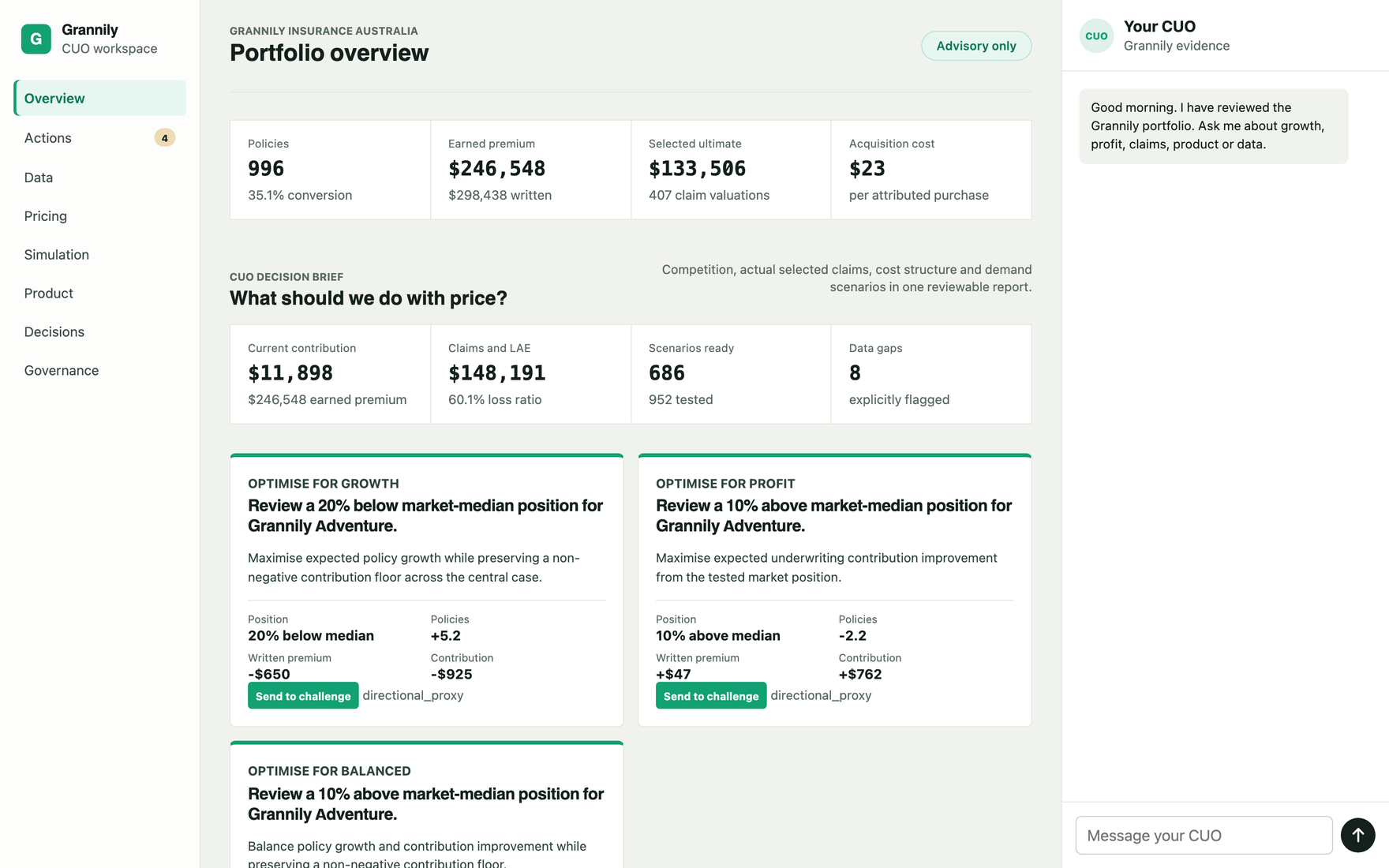
Portfolio overview: policies, earned premium, selected ultimate claims and acquisition cost, above a CUO decision brief proposing growth and profit options.
Portfolio overviewThe book's position and the decision brief: what to do with price, with contribution, loss ratio and the count of explicitly flagged data gaps in view.
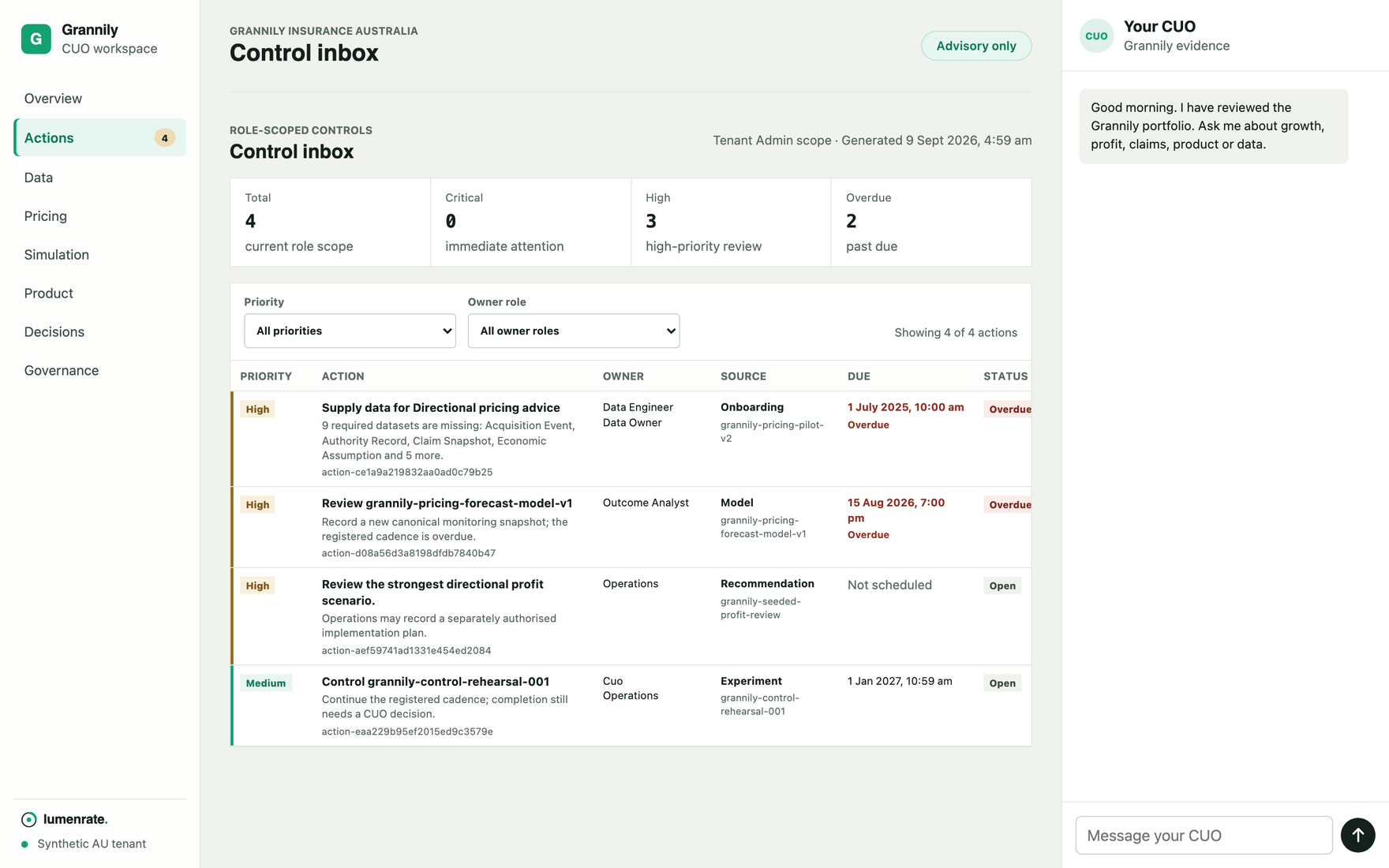
Control inbox listing role-scoped actions with priority, owner role, source and due date.
Control inboxActions routed to the role that owns them, with what is overdue stated plainly.
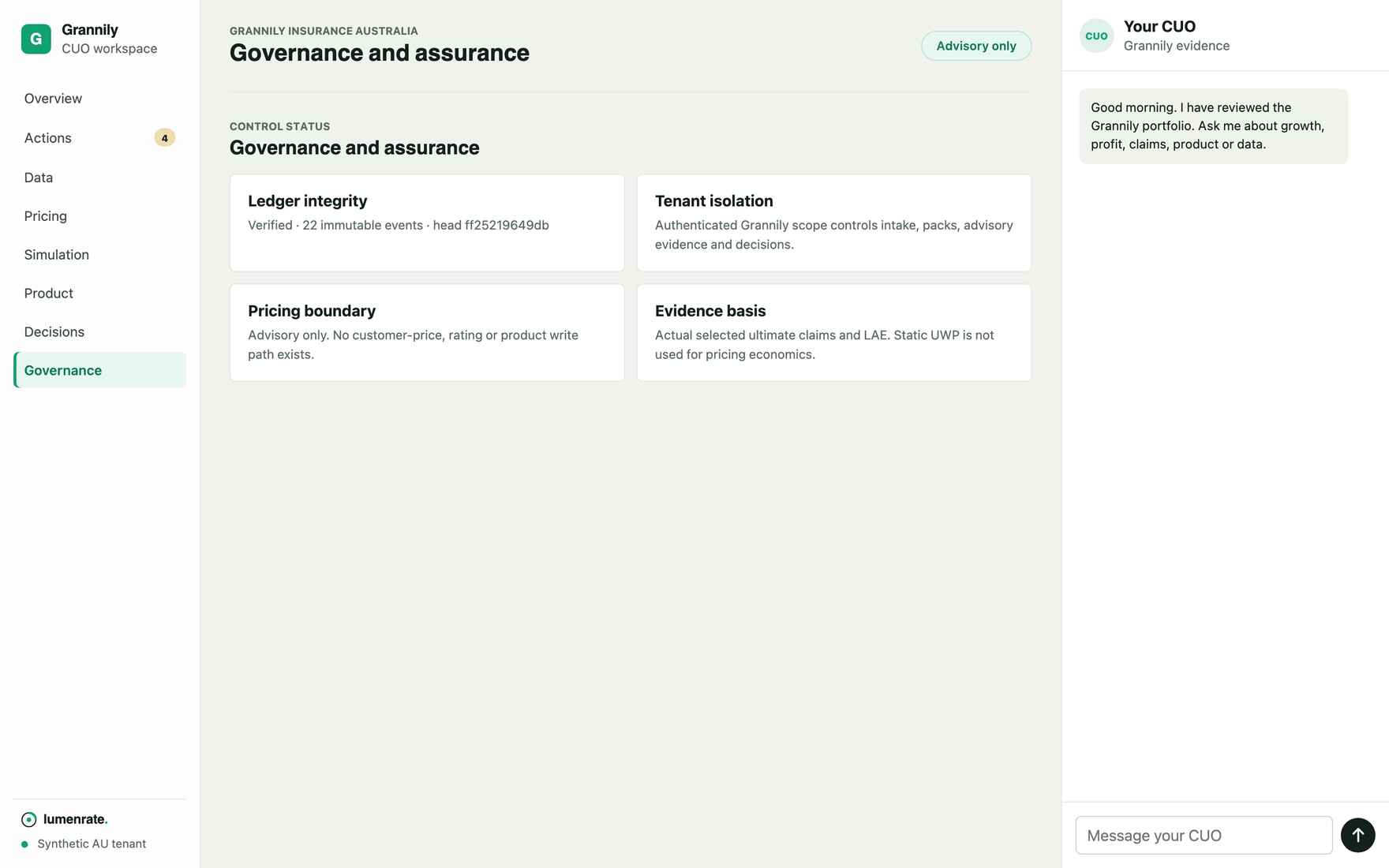
Governance and assurance panel showing ledger integrity, tenant isolation, the pricing boundary and the evidence basis.
Governance and assuranceLedger integrity, tenant isolation and the pricing boundary, asserted by the platform itself.
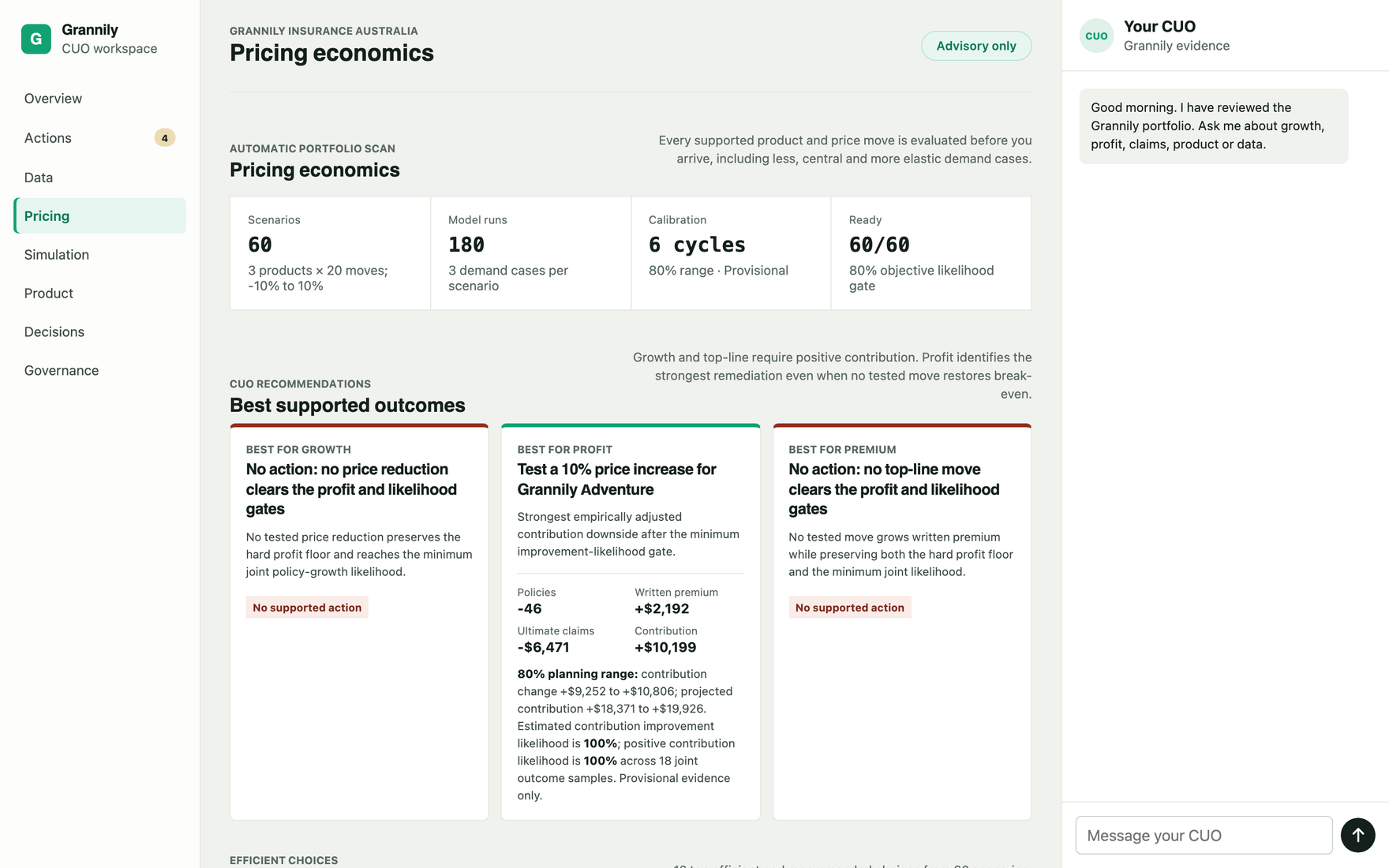
Pricing view showing segment-level positions and candidate actions.
PricingSegment positions against the market, and the candidate actions that follow from them.
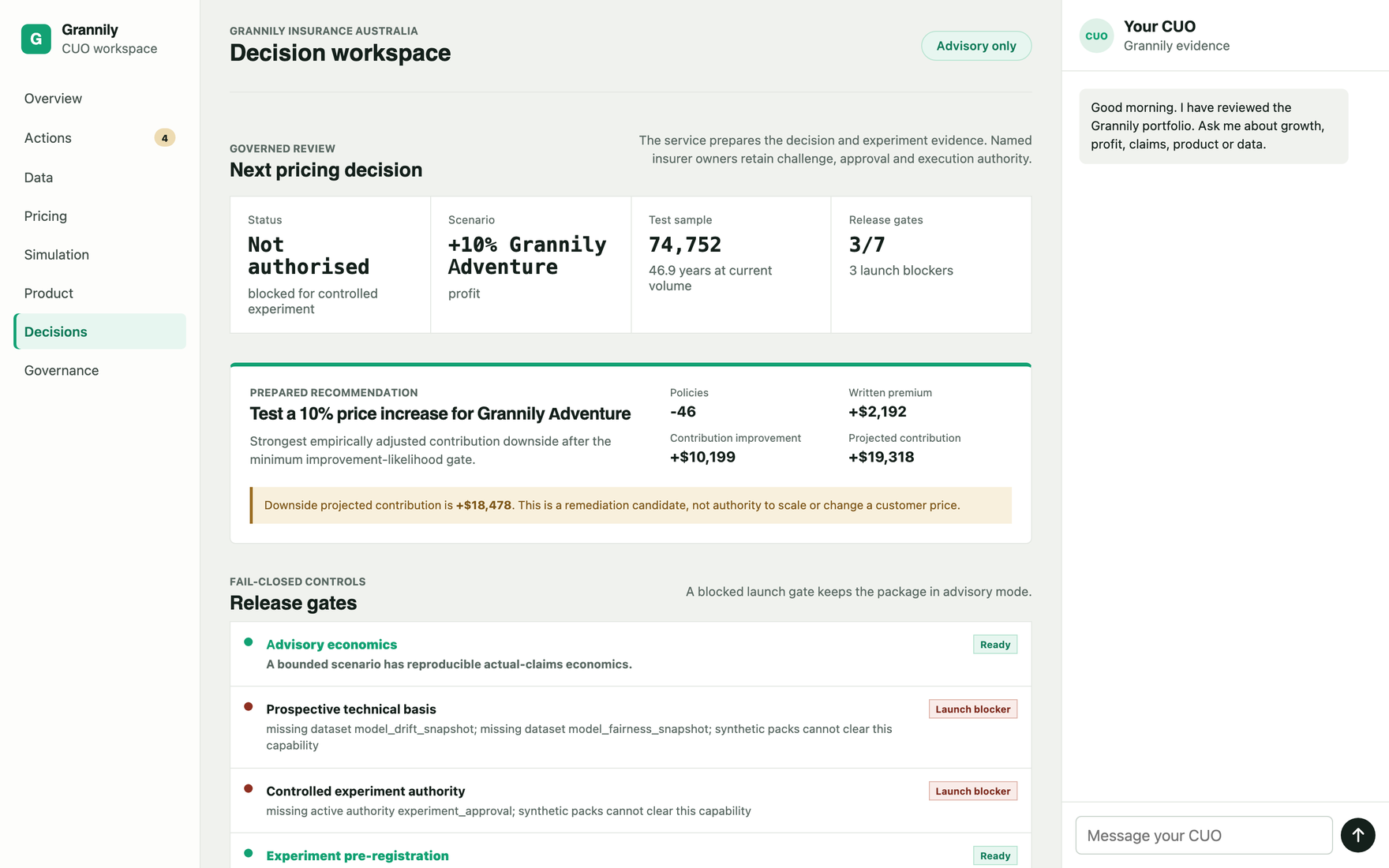
Decisions view showing the recorded decision cycle.
DecisionsThe recorded cycle: what was recommended, decided, implemented and observed.

The workspace marks itself a synthetic tenant and carries an advisory-only badge on every screen. In the governance panel the platform states its own boundary: no customer-price, rating or product write path exists. A demonstration runs on this same book.

05  /  GOVERNANCE

Automation is earned through six gates, not enabled by configuration.

Each stage requires the preceding stages' evidence to hold. A breach at any point reverts the platform to a safer stage automatically.

A model in Lumenrate may retrieve evidence, explain a recommendation, and challenge it. It may not select a customer price. It may not execute one. No code path exists that would allow it.

LedgerRejects any decision event not marked advisory-only, and allowlists payload fields.
Contract schemaPins non-executable status as a fixed schema constant, validated on every result.
Compute layerHard-codes non-executable output; downgrades ungoverned results to research only.
API surfaceDeclares the advisory-only boundary on its own health endpoints.
NAIC AI Model Bulletin Colorado SB26-189 APRA CPS 230 / CPS 510 NY DFS AI guidance State filing & rating-plan discipline

Lumenrate maintains a standards register and jurisdiction matrix mapping each capability to the regimes above. Alignment is designed in and evidenced; regulatory approval remains a matter for your own filings and counsel. Read the security architecture

06  /  THE RECORD

Every decision, on the record

Five event types chain each pricing decision from proposal to measured outcome. Events are append-only with deterministic digests.

Audit-ready by default. The pack a team would assemble for a market-conduct review over several weeks exists here as a query.

Institutional memory. Pricing decisions outlive the people who made them, with the reasoning intact.

Evidence compounds. Outcome events improve the advisory layer measurably, decision by decision.

07  /  ENGAGEMENT

The six-week governed pricing assessment

A fixed-scope engagement on your own market and your own book — the most direct way to see the platform working on decisions your team currently faces.

WEEKS 1–2

Competitive market grid live for your products and segments. No internal data required.

WEEKS 3–4

Your data connected under governed contracts; advisory artefacts running on your book.

WEEKS 5–6

A ranked, evidence-graded set of pricing opportunities, and the evidence-gap report your team retains either way.

Book the assessment

Or begin with a 45-minute walkthrough on the synthetic demonstration book.

08  /  DUE DILIGENCE

Direct answers

The questions a pricing or compliance lead should ask before a first meeting.

Does the model set prices?

No. This is a matter of architecture rather than configuration. The advisory layer produces deterministic artefacts, and the copilot's answers are deterministic too: each carries its evidence references and caveats. No execution path exists from a model to a customer price, and automation beyond advisory sits behind six evidence gates, each requiring named-human approval.

Where does our data reside?

Within your tenant's scope, enforced by the database itself: forced row-level security on every tenant table, write-once object storage, and a scope derived from your verified identity. Isolation is logical, in a region-pinned deployment; a dedicated per-tenant deployment is a roadmap option. There is no cross-tenant learning and no pooling of your book with another insurer's.

What is shown in a demonstration?

A complete synthetic insurance book: market grids, advisory artefacts, the decision ledger and the evidence-gap reporting, all on invented data. We do not demonstrate on another insurer's information, which indicates how yours would be treated.

How does this differ from a pricing optimisation engine?

Optimisation engines answer which price maximises a chosen objective, and leave the customer to defend it. Lumenrate answers a different question: which actions are available on today's evidence, within your authority — and what would be required to responsibly do more. That is the question boards, regulators and reinsurers are asking.

What is required to begin?

The assessment begins with market intelligence only; no internal data is required for the first two weeks. Data connection then proceeds under explicit governed contracts, one source at a time, with visible quality and freshness gates.